The hammer didn't build the shed.
Why we forget our own grammar when the tool is AI, what we lose by refusing to say what we actually did, and why doing AI-assisted work honestly is its own skill.
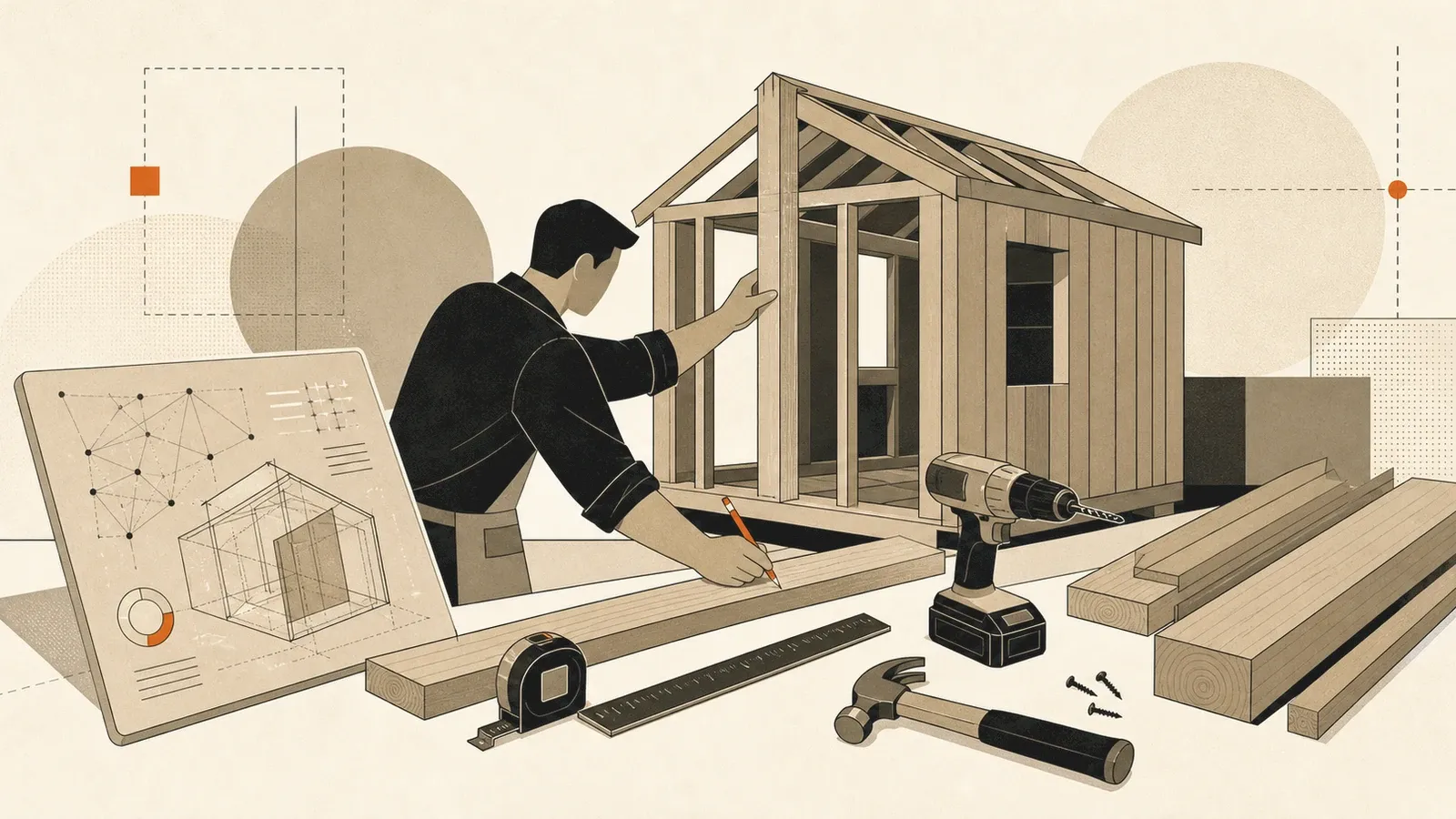
When you build a shed, you use tools. A hammer. A drill. A circular saw. When you finish and look at it, no one walks up and says, “You didn’t build that shed. The drill did.” The sentence would be absurd. The drill is an instrument. You drove the screws. You decided where they went. You picked the lumber. You made the shed.
When you build a financial model, you open a spreadsheet. Excel does the arithmetic. No one walks up and says, “You didn’t do the analysis. Excel did.” Again, the grammar would be absurd. Excel is an instrument. You decided what to model. You decided which assumptions to make explicit. You decided what counted as a result. You did the analysis.
But somehow, when the tool is AI, the grammar inverts. A student uses an AI agent to help draft a paper and the conversation snaps to “the AI wrote it.” A consultant uses an LLM to scaffold an analysis and the question becomes “should the client know it was AI?” A researcher uses generative AI to accelerate a literature review and quietly does not say so, because saying so would invite the suggestion that the researcher did not do the work.
This is not a small grammatical slip. It is a category error, and it has consequences.
Tools don’t have agency
A drill rotating in midair builds nothing. A drill in your hand, on a screw, with intention, builds something. The doing is not in the drill. It is in the entanglement of the drill with the human action that uses it. Excel sitting closed on your laptop has not analyzed anything. Excel open, with assumptions and formulas and intentional structure imposed by you, has analyzed something. The doing is the entanglement, not the artifact.
Information systems researchers have a name for this. They call it sociomateriality: the recognition that what counts as “the work” is not a property of the tool and not a property of the human, but of the constitutive entanglement of the two. Tools afford. Humans do. Neither one acts alone, and asking “did the tool do it” is the wrong question. The right question is “did the entanglement produce something, and which side of the entanglement decided what good looked like?”
For drills and spreadsheets, this is so obvious we don’t even articulate it. The reason we don’t say “the drill built the shed” is that we have never had a moment of cultural anxiety about the drill’s agency. We can see the drill clearly. We are not afraid of it.
We are afraid of AI. That fear is doing the grammar.
The new work is different
There is one thing that does change between a drill and an LLM, and it is worth saying honestly. The drill cannot surprise you with an output you had not anticipated. The LLM can. The drill applies force in the direction you push it. The LLM can hand you back a draft, an interpretation, an analytical move you would not have produced yourself. The asymmetry is real. It is the source of both AI’s usefulness and our anxiety about its agency.
But surprise is not agency. A friend can surprise you with an interpretation, and we do not say the friend wrote your paper. A search result can surface a citation you would never have found, and we do not say Google wrote your literature review. A peer reviewer can return a comment that completely reframes your argument, and we acknowledge the reviewer in the footnote, not as a coauthor.
The criterion for whether you did the work is not “did you do it alone.” It is “did you do it.” Did you decide what to make? Did you decide what counted as good? Did you read the agent’s output and recognize what was wrong, and revise? Did you choose what to keep and what to throw away? Did you frame the problem the work was meant to address? Then it is your work. The instrument is just different than it used to be.
This is why I have been writing about conducting and composing. In an AI-assisted workflow, the player work (executing the deliverable) is increasingly done by the agent. The work that remains is conductor work and composer work: directing the agent, verifying its output, deciding what is worth producing in the first place. That work is not less than playing. In many cases it is harder. And it is recognizably, structurally, your work.
The disclosure paradox
The misgrammar produces a concrete harm. When people fear that admitting to AI use means admitting they did not do the work, they hide it. They use AI and say they did not. They use AI heavily and disclose it incidentally. They use AI for the structurally important parts of the work and disclose only the cosmetic parts.
A current paper of mine calls this the disclosure paradox: the more constitutive AI’s role in a piece of work, the greater the stigma associated with admitting that role, which creates a systematic bias in which the most transformative uses remain invisible to the field. This is bad for the field. We cannot develop honest norms about a practice we cannot see. We cannot teach what we will not name. We cannot evaluate whether someone is doing the conductor and composer work well if we are pretending the player work was done by hand.
The disclosure paradox is downstream of the grammar. The grammar that says “the AI wrote it” is the grammar that makes honest disclosure feel like surrender. Fix the grammar and the paradox loses its grip.
What to do
The right correction is not to inflate the tool’s agency until it matches our anxiety about it. It is to recognize that the work is now different, and to teach and credit and disclose accordingly.
Practically, in my own work, this has moved in two stages.
The first stage was about permission and disclosure. In the classroom, I made it a requirement that students describe how they used AI on every assignment where it was permitted, and I graded the description as part of the work, because describing what you did is part of having done it. In my own writing, I disclose AI use specifically: which sections an agent touched and what role it played.
The second stage is about requirement. Where conducting and composing are the actual deliverable, AI use is now required, not merely allowed. Doing the work without AI in those settings is doing the wrong work; it is rehearsing a skill the world is no longer asking for. Where the point of the assignment is to build the underlying fluency that makes conducting possible at all, AI is forbidden. The two policies are saying the same thing: the assessment should match the work, and the work is now split across two kinds.
In the curriculum redesign, assignments are structured so that the building is the easy part. The tools do that. The actual deliverable is deciding what to build, supervising the build, and recognizing when the build is wrong. Doing the easy part well is no longer evidence of mastery. Doing the hard part well, with the tools that make the easy part easy, is.
The grammar we need is simpler than the cultural anxiety has let us write it.
You did the work. The tools were different. The work is what we should be teaching ourselves to do well, and to be honest about doing.