Learning in a different order: the judgment work no longer has to wait.
For generations, learning ran one way: master the basics, prove you can execute, and only much later earn the judgment work of deciding what to make and whether it is any good. Generative AI does the execution now, so the judgment no longer has to wait.
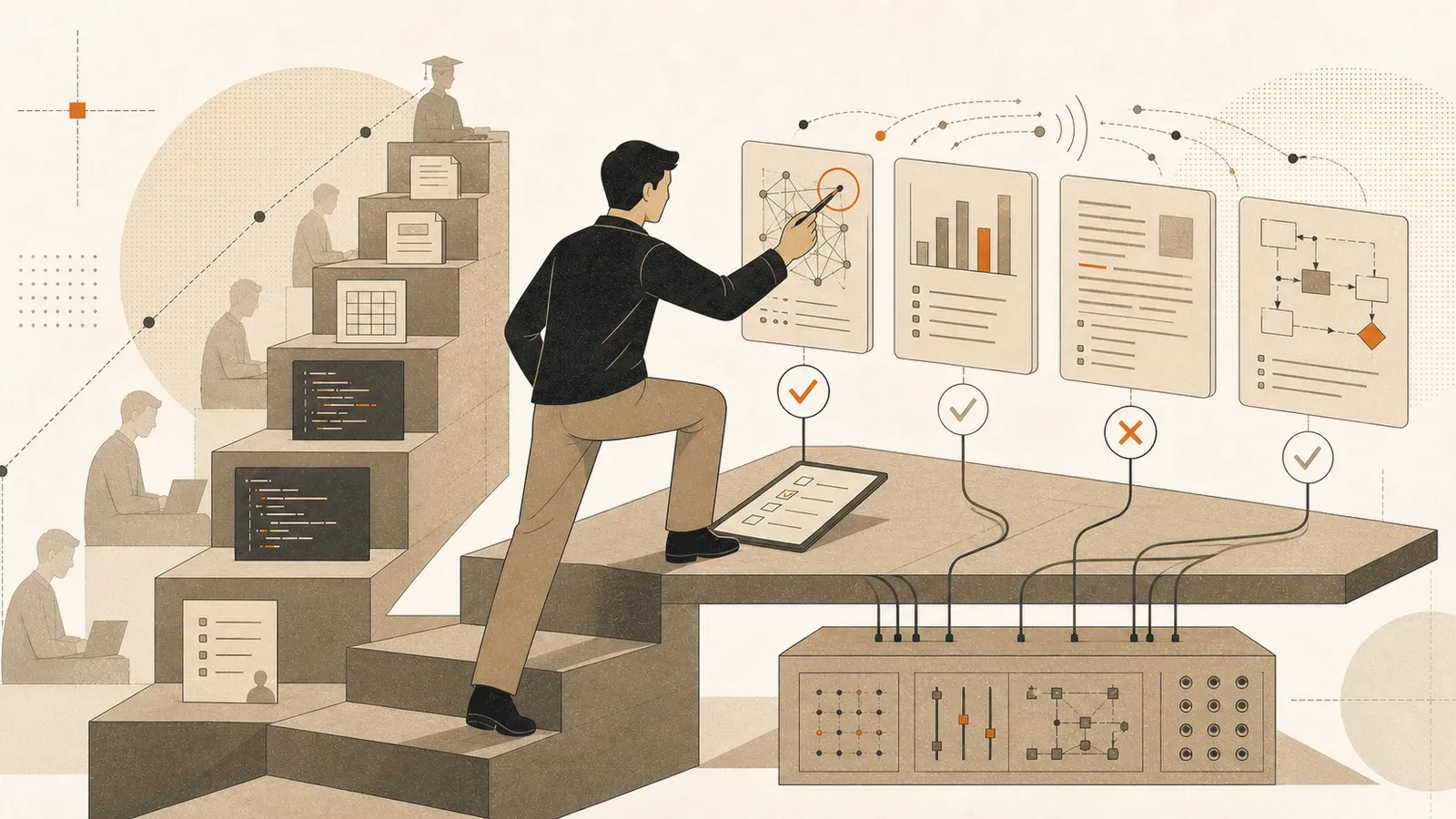
Almost every field teaches in the same order. First you learn the fundamentals. Then, once you have proven you can execute, you are slowly trusted with judgment: which problem is worth solving, whether the answer is any good, what to do when the textbook runs out. The prerequisite chain, the lecture and then the exam, the years of coursework before a dissertation, the entry-level job that is all execution and no decision. The arrangement is always the same: you earn your way to the interesting questions by first proving you can do the work underneath them.
There was always a cost folded into that sequence. The most valuable part of the work, deciding what to make and telling whether it is any good, came last, and for many people it came late or not at all. We spent the bulk of a student’s time on the part a person does least of over a career, and left the part they do most of for later: picked up on the job by whoever made it far enough up the ladder to be handed it, or sold back to them as still more school.
Why the order was fixed
It is worth being precise about why we taught this way, because the reason is about to stop being true. The order was fixed because the only way to learn the work was to do the work, and the work, at the bottom, was execution. To learn to analyze, you analyzed. To learn to model, you modeled. You could not practice directing an analysis without first being able to produce one, because someone had to produce it, and that someone was you. Execution was not just the first skill. It was the toll you paid to get anywhere near the others.
What breaks the order
Generative AI does the execution. The model gets built, the code gets written, the first draft gets drafted, and not by the person who used to have to learn how. I have written elsewhere about this through the image of an orchestra. An orchestra runs on three kinds of work: the players, who turn the score into sound; the conductor, who shapes how the piece goes and judges whether it is any good; and the composer, who decides what is worth playing in the first place. Training has always seated students in the first chair, as players, and left conducting and composing for later. AI changes which chair a beginner can take. The agent becomes the player, and what is left for the human is the conductor’s work and the composer’s work. So the thing we always made students master first, the ability to execute, is no longer the toll it was. The judgment work does not have to wait behind it.
This is the inversion I have come to think of as learning in a different order. In a research paper I am finishing I call the same move execution-first learning, because there you produce first and acquire the theory through producing rather than before it. In a classroom the shape is the same. A student briefs an agent and ships a working analysis in an afternoon, then spends the real hours of the course on the questions that used to be reserved for the experienced: was this the right question to ask, is the output actually true, what would you say if you had to defend it to a board. They are conducting and composing from the first week, badly at first, and learning it the way anyone learns anything hard, by doing it and being wrong and doing it again.
Conducting was always two jobs
It helps to be precise about what a conductor actually does, because we tend to describe only half of it. We picture the directing: setting the tempo, shaping the dynamics, deciding how the piece should go. That half is real, and it is the glamorous one. The other half is quieter, and it is most of the work. The conductor verifies. They hear the note that came in flat, the entrance that landed late, the passage that is technically flawless and playing the wrong feeling entirely. Directing decides what should happen. Verifying catches what actually did.
And nearly all of it happens in rehearsal, before there is an audience. By the time the hall fills, the flat notes have been caught and corrected, and what the audience hears is the performance that survived the verifying. The same holds in any working context. The performance is the moment the work goes out: the analysis presented to the client, the brief filed with the partner, the paper submitted to the reviewer. Verification is the rehearsal, the pre-publication pass you make while the work can still be sent back, before it has an audience at all.
When the players were trained humans, the verifying could stay in the background, because the ensemble verified itself. Each player is listening to the others, the section leader to the section, and a missed entrance gets caught and corrected across the group long before it reaches the conductor. The checking was distributed across many trained ears. An AI player gives you none of that. It plays fluently and wrongly at the same time, alone and at speed, with no section listening back, and it will hand you an analysis that is well-formed, persuasive, and quietly built on a number that does not mean what it says. The verifying the ensemble used to share now lands entirely on you. Directing such a player is the easy part. Catching it is the whole job.
What still has to come first
The obvious objection is the one the old order was built to answer, and it is a good one. You cannot verify work you do not understand. A student who has never built a model cannot tell when the model is lying. Hand someone the conductor’s job before they can hear, and you get confident nonsense delivered on schedule.
That fear is legitimate. But the old sequence was not the only way to answer it. Doing the hard part first does not mean doing it ignorant. To direct an agent you need enough fluency to know what to ask for, and enough to recognize a confident wrong answer when it comes back. So the fundamentals do not leave the syllabus. They stop being the finish line and become the floor: enough Python to read and debug what an agent writes, enough statistics to catch a model that cheats, enough of the craft to hear when the music is off. You build just enough of the ear, deliberately and early, and you stop pretending that years of execution drills are a prerequisite for being allowed to think.
This is the principle I am rebuilding my own courses around. Where the deliverable is judgment, the conducting and the composing, AI is required, because doing that work without it now means rehearsing a skill the world has stopped asking for. Where the point of an assignment is to build the ear that makes judgment possible, AI is off the table, because the fluency is the entire point and an agent would only rob the student of it. The two rules look opposite and are saying the same thing: the work has split into two kinds, and the assessment should match the kind in front of you.
Where judgment comes from
Here the objection sharpens. Judgment is supposed to come from experience, and a beginner has none. If you have never been burned by your own bad analysis, what do you direct the agent with?
But experience never trained judgment directly. Feedback did. What built taste was not the hours of manual execution; it was the consequences those hours exposed you to: the assumption that broke, the framing that did not convince the room, the number that turned out to be lying. Execution was just the slow vehicle that delivered the feedback, one painful rep at a time. We assumed judgment took years of doing the work because doing the work was how the feedback arrived.
Take the execution away and the feedback no longer has to come slowly. A student who is not hand-building the analysis can direct and evaluate twenty of them in the time it once took to grind out three: twenty chances to be wrong about what matters instead of three. What it requires is that someone supply the “you were wrong.” When the work was execution, the compiler and the arithmetic said it for you. When the work is judgment, the instructor, the rubric, the client who cannot be fooled, the consequence that actually lands, has to say it instead. Engineering that feedback is the new teaching, and without it, doing the hard part first is just doing it badly on a loop.
This will not hand you a finished practitioner at graduation; some judgment still only arrives on the job. But a student who has been judging, and being corrected, from the first week arrives with more of it than one who spent those years executing and was handed judgment at the end.
The risk worth naming
The danger here is real, and it is not that students use AI. It is that we let the fundamentals quietly slide off the syllabus altogether, mistake the new order for no order, and graduate people who can direct an agent fluently but cannot tell when it is wrong, because they were never made to learn the underlying craft well enough to hear it. That failure is easy to reach by accident. It looks like progress right up until the moment someone needs to catch an error and no one in the room can.
So the different order is not the absence of an order. It is a more deliberate one. Decide which parts of the craft a person still has to own in their own hands, teach those without shortcuts, and spend everything that used to go to execution drills on the judgment that always mattered most.
The order we inherited was never a law of learning. It was a workaround for a constraint that no longer holds, that the only way to reach the judgment work was to spend years first earning the right to it through execution. The constraint is gone. The hard part, the part that was always the point, no longer has to wait. We can ask students to do it first, badly, on purpose, and to learn it the only way anyone ever has. By doing it.